

the anti-aging mistake that thins your skin after 40
Dave Asprey sits down with Young Goose to break down why decades of acid-based skincare left skin thinner, and what actually works at the cellular level: methylene blue, red-light DNA repair, Vampire Exosomes, and NAD+. Enjoy 10% off with code DAVEASPREY10.

go beyond hydration. reprogram aging
Most skincare just treats symptoms. Young Goose targets the root causes of skin aging—where biology, metabolism, and genetics intersect.
By addressing the core processes behind cellular decline, we help extend your skin’s healthspan:
- Replenish NAD+ to restore energy and repair
- Activate autophagy to clear cellular waste
- Strengthen the extracellular matrix for firmness + elasticity
- Stimulate sirtuin + NRF2 pathways to slow biological aging
- Reverse oxidative and UV-induced damage
It’s the biohacker’s approach to visible transformation—proven, precise, and powerful.
watch: dave asprey on the science of skin longevity
biohack your skin from anywhere
Our Longevity Facial Kit delivers the same potent molecules and rejuvenating experience we offer in-person. Designed for anyone ready to bring biohacking into their daily skincare. Enjoy 10% off with code "DAVEASPREY10".

Young Goose
LONGEVITY CARE PROTOCOL
Share


what is inside
-
ADAPTOGENIC CLEANSER
Gentle Longevity Face WashRegular price $42.00 USDSale price $42.00 USD Regular priceUnit price / per -
YOUTH RESET
Anti-Aging SerumRegular price $196.50 USDSale price $196.50 USD Regular priceUnit price / per -
YOUTH DAILY
Skin Longevity MoisturizerRegular price $176.50 USDSale price $176.50 USD Regular priceUnit price / per -
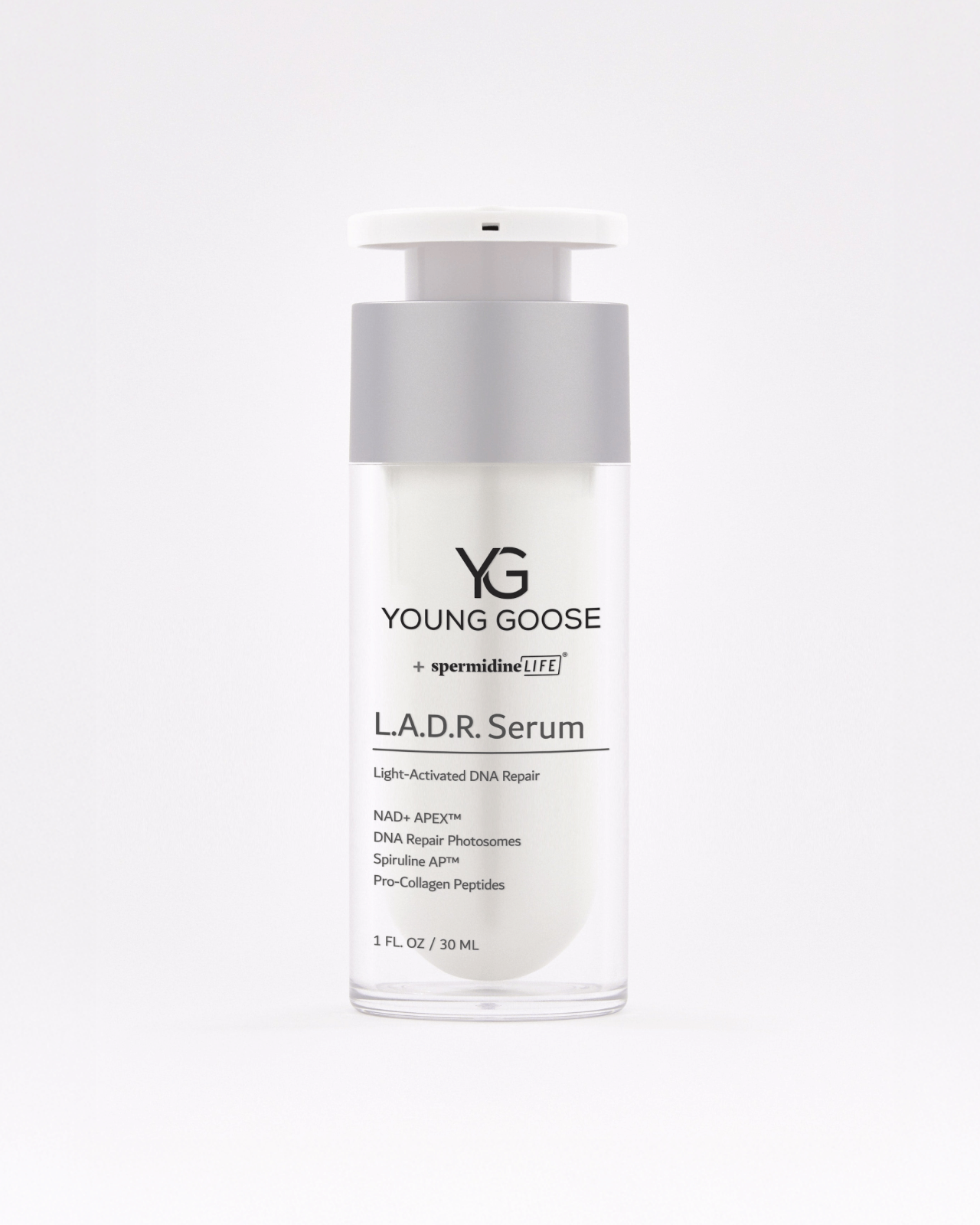
L.A.D.R. SERUM
Red Light-Activated Antioxidant SerumRegular price $196.50 USDSale price $196.50 USD Regular priceUnit price / per


how it works: your longevity care routine in 6 simple steps
-
step 1: cleanse
Start with the Adaptogenic Cleanser to gently purify the skin, calm inflammation, and support NAD+ production for optimal cellular function.
-
step 3: repair
Apply YouTH Reset, a powerhouse serum packed with NAD+ precursors, spermidine, and Peptides to activate deep cellular renewal.
-
step 4: enhance
Follow with L.A.D.R. Serum, designed to supercharge DNA repair and mitochondrial energy—especially when paired with red light therapy or natural sunlight.
-
step 5: hydrate & fortify
Seal in treatment with YouTH Daily, a rich longevity moisturizer that firms, protects, and restores youthful resilience.

that’s why biohackers trust it
When it comes to human optimization, biohackers don’t settle. Young Goose delivers skincare rooted in longevity science—using NAD+ precursors, spermidine, and copper peptides to fuel cellular repair and performance.
- Upgrade resilience and performance
- Optimize cellular health
- Reduce inflammation and oxidative damage
- Support biological function without unnecessary additives
Our formulations are designed to enhance the body’s natural intelligence—not override it.
The Human Upgrade with Dave Asprey
Episode transcript
Read the full conversation
The skincare world of the past 20 years, it was really like acid dominated. Wats literally burn the top layer. Some of them 40s, 50s, 60s, really compromised skin barrier, much much thinner skin as we grow older. The wrinkle is just a symptom.
A lot of people buy really expensive stuff and it may or may not work for them. Once you find something that works, you're like, "Wow, it increases collagen thickness." I saw this.
You really get radiant, glowing skin. You're listening to the human upgrade with Dave Asprey.
What do you think about biohacking beauty? Well, actually, I'm a guy, so maybe just biohacking your skin might be the thing. I have the hosts of the Biohacking Beauty podcast here with me and they're also the founders of Young Goose, which is a longevity focused skincare company that I've used for I think six or seven years now. Uh they make uh some really good stuff. And we're going to have a conversation today about skin and how skin relates to aging. And these are some very interesting humans because Amitate here is the CEO. He's got 10 years of working in health and wellness and Anastasia is a co-CEO with biomedical research experience in liver fibrosis and breast cancer. So this is a sciencebased conversation about what do you do to have skin that lasts for at least 180 years, which is at least as long as I'm planning to live. And if you're thinking that I'm crazy, I'm thinking you're crazy for planning to die sooner. So, uh, let's race.
Welcome to the show, guys.
Thank you.
Thank you. Thank you. So excited to be here.
What's new in scan? We all have heard, oh, maybe you can use some peptides, but they don't absorb. So, like what what's going on?
Um, I would love for maybe for you to tell them about the new testing we've developed. And uh because I think the audience that listens to this podcast is all about measuring and testing rather than just hoping for the best.
You know, I I'll start with the fact that if you ask if you ask your favorite LLM, what's what's the next frontier in in skin health? He's going to talk vaguely about uh personalization and maybe mention some peptides. But the reality is is that um we are now able to understand how a an individual will react to a specific product. And that's the real Yeah. Yeah. That's the real
That's cool. And this this is a frontier that uh anyone from your favorite provider to your scanner uh your AI scanner on your phone is going to be able to gleam. So
how does that work? Is this a lab test? Is this optical? Like how do I know? I think a lot of people buy really expensive stuff and it may or may not work for them. Once you find something that works like wow.
Yeah.
So tell me more about the testing of the skin. So, a lot of it is going to be driven through AI and and visual. So, there's endless amount of money being being uh spent right now on trying to figure out how with your camera phone you're you're going to be able to get very deep in insights. And by the way, that's not only uh as far as uh your skin. Obviously, you did a podcast with Throne, which is which is a
one you put on your toilet toilet. And there are other ones that are should that should look at uh different markers. But as far as the skin AI right now is I'll give it a five out of 10 as far as how well it could
just from an iPhone.
Just from an iPhone. Yeah.
Okay.
Uh but what we did is we uh partnered with uh four PhDs from ASU that they have a company called Theion and we designed a test that with a dry blood spot test. The same way you'll test your ketones or anything else. You'll send it to a lab and we'll be able to assess your skin's metab metabolic age really like how well your cells
from blood
from from dry blood spot. Yeah. So you don't even need to draw like a whole vial just one drop.
How does that work? Like what are you measuring?
You're measuring metabolites. The science is called metabolomics.
Yep.
And basically what you're assessing is how well your skin cells produce things. Basically how well they interact with the food that you're eating etc. and then are able to sustain themselves and produce different things that we are all maybe familiar with maybe not like NAD and substrates of NAD or spermadine or different we look at 17 different metabolites.
Wow.
And we can we can understand not only your skin's metabolic age but also what can we do in order to affect that topically like what products you would need in order to change that and then obviously you can retest. So it's sort of like Viome for your skin, you could say.
Yeah.
Wow. Okay, that's incredible. Is this commercially available?
Yeah, we have practitioners that are that are offering that because at the end of the day, nothing is um
you know, applying something on your skin is great, but you definitely want a holistic approach. You want to approach it from the inside about, you know, what you're eating, what your supplement regimen is like. So yeah.
Okay. Why wouldn't I just do what the guy who invented Vaseline did? He he just would smear it on his face every day and eat a tablespoon of it and he apparently had good skin as what's the difference between like
well putting something on your skin and putting the right thing on your skin.
I think um having a good skin is so subjective. It can be it can look different to people. It can feel different and everyone also has different biology, different environment. like I don't know how he led his life and if it really was great
but I also think that the reason we are if I may say as successful as we are
uh is that people kind of like um caught up with the math of how the current skincare paradigm and world worked um until now where it was all about just maintenance uh and uh maybe like tweaking in spas and medical spas. So, so like if you wanted to see a change in your skin, you were bound to go for aggressive treatments and then everything that was on the market um was very very superficial. But then as the science of longevity progress and now we we are able to really look at the processes that drive aging and not only um help people like hope for better looking skin but better functioning skin actually understanding that as we grow older the wrinkle is just a symptom like what happened underneath. Oh, it might be decline in cellular energy. It might be now uh is the barrier is compromised and it's has much lower resilience. So all of these processes we were able to look at them, understand them and give people protocol of how to address them. That hasn't been done until we really brought it to market.
Yeah. I'll say also I you know what he did maybe is the most rudimentary most bas basic way to biohack your skin, right? because losing moisture is is is a part of skin aging. So if you can prevent the loss of moisture to some extent you're biohacking your skin.
Okay.
The question is is it the most uh comprehensive or sophisticated biohacking? Probably not. And also if we talk about petroleum jelly specifically good
not the best you're you know you're you're uh you're not you're you're harming many other things. And that I think is the is actually uh the point here that what you want to do is affect as best possible the most amount of the what we call the hallmarks of aging which are the 12 mechanisms the 12 names we gave
right
things that are going wrong in cells and it applies to the skin. So if you can target as many hallmarks in the best way you are going to have you mentioned 180 that's really the way to look at your skin. It's not I wake up in the morning after I applied something for one time and I want to see that my face is completely overhauled. No, it's uh what is your strategy for the long run to get the best skin tomorrow, next year, in 10 years, in 50 years.
Okay. I just got back from Switzerland a couple days ago. Uh, I was speaking at the longevity investors conference intad. That's a lot of time on airplanes
and I probably should do something other than just put on moisturizer right before uh before I fly which I do every morning.
What should you do on an airplane in order to not get old skin?
Well, um I think if we I ideally you'll do like your full skincare routine that has a little bit more steps than a moisturizer.
How many steps do I need? Um I think for airplane I'll I'll I'll share what I do and then um
yeah so before the trip I start uh with the mist of the blue peptide spray and have you tried it?
The mist I haven't gotten a mist from you guys I don't think.
Okay. Okay. We'll make sure to fix that.
But uh yeah it's one of our newest products and it has met me blue in it.
Oh I have not tried this. I I've been wanting someone to put methylene blue in skincare because it increases collagen thickness. I I saw the studies. I used to put it myself in stuff,
but then I put too much one time and I turned blue.
Yeah. Actually, our friend Lauren from Kalia told me right before we launched the the the spray when she saw launching. She's like, "Oh my god, I was doing it myself like in the kitchen and finally I don't have to do it." So yeah, we made sure.
Amazing.
Yeah, it took a while to formulate not to make people look like smurfs, right?
Um so we had to develop like anti-stain technology. But besides me and blue, there is also SOD there. There's JHKCU. So, it really is um like a mitochondria potentiator. So, we missed with the spray first. It also has rehydrates your skin after the night. And as you mentioned, the the skin loses moisture all the time and especially during the nights. We want to rehydrate. Then, we want to apply a serum. Um I would uh recommend for the flight to use our U3 set. It's kind of a longevity stack. It has our key um molecules that we brought to market. So complex of NAD+ precursors, it has spermodine and then it has um supportive molecules like erosion, resveratrol. Um then you layer the moisturizer that you mentioned. And then if you really want to be um to like have the best results, you got to apply our hyperbaric mask. It's the good way to use an occlusive. We talked about occlusive and using petroleum jelly. So that's um that's a much better way to uh achieve
and what does that look like?
It's like it's a it's a pink jelly mask. Um and uh the key ingredient there is actually yeast extract that oxygenates your skin tissue. So you actually yes you're getting uh more oxygen to your skin. As you know as we grow older we unfortunately start to do it worse and worse. So it reexagenates your tissue. You really get radiant glowing skin which hard to get when you get off the airplane. And then last but not least, you might disagree with this one, but we recommend to use our sunscreen on a plane because it also protects from visible light.
Does it is it mineral based or on% mineral based?
I actually agree with that. Protecting yourself from indoor lighting with sunscreen makes great sense because it it's just bad for you. There's another ingredient there that is becoming extremely po one of the ingredients we're proud to have been the first ones to use and it's becoming very um popular right now with high-end like medical grade skinare is a a product called ectoin and oh we talked about it it's from space teddy bears it's from tardig grits
and it structures uh water around proteins so any type of radiation is being mitigated with with ectoin you need high levels. You can't have just like
Is this actually tardigrade juice?
It's tardigrade juice. Yeah, that's how you call it.
And if if you've never heard of a tardigrade, it's not something out of Doctor Who. Um these are these incredible little they're called water bears and microscopic creatures um that survive better than anything else we know.
Yeah.
Other than maybe some spores. Like there's some spore forming probiotics that can also survive in space like that.
Yeah. So it's the fact that they have this protective protein that lets them survive in the most acidic environment and the most unlivable habitats because they keep repairing their protective barrier. So and obviously we want that for our
So that's the specific protein that does that.
Wow. Okay.
No tardigrades were harmed uh during the
How do you juice them without harm? Do you
call them and you ask? Very nice.
You gently milk the tart grade and put it on a tart grade reserve when you're done. Oh, you can synthesize the protein and and leave them alone. They're hard to catch. Uh, another thing, so something that Anastasia another ingredient that once we say it is probably people are probably going to start uh seeing it in in other skincare products, but uh we're very proud to be the first ones to have used it is ergoine, which
I was going to I was going to bring that ergoine and sod
Yeah. are really unusual but really important. So let's go through this in order. Let's talk about erothionate and we have covered that on another episode using it orally. Yeah, it's like the next glutathione.
But what's your take on it? Why is it important?
First of all, it is the next glutathione because it's the previous glutathione. It's it it helps your body create glutathione through NRF2, but which is a pathway. It's like a detox pathway. But the cool thing about uh ectoine I'm sorry about erotining is that it's a mitochondria specific antioxidant.
Correct.
So uh there are some studies showing that it has better bioavailability topically than orally.
Oh that's interesting. Okay. And that way we're able to absorb that specific uh amino acid which which which goes directly to the mitochondria and combat oxidative stress in the mitochondria which obviously is the mito while there's research that came out now that oxidative stress in the mitochondria is one of the large the biggest drivers of scinessence.
Yes. So what and mice that got that uh enabled in them had significantly less scinessence or disabled in them got significantly less scence. So this specific antioxidant is incredible at kind of controlling the amount of energy we're making as opposed to the amount of damage we're creating during that process. the collateral damage of energy production and super oxide disysmutase. I know a lot of people call glutathione the the body's innate antioxidant but s superoxide dismutase is there in the corner crying because people forget about it cuz it's the together with glutathione this is the body's innate way to defend against antioxidants there are specific DNA segments that are responsible to encode superoxide dismutate dismutase sod and it has been extremely difficult to have it avail bio available both orally and um topically, but in recent years there has been great improvement. So, we can get it in products.
That one's really interesting because if someone has chronic inflammation, which certainly was me for a long time,
um you have too much superoxide, which is a free radical that's made from combining air and food.
It's like the exhaust that comes out
and then the body's supposed to make SOD that cancels out the exhaust. problem is if your SOD production is offline, you get just masses of inflammation.
Yeah.
Uh so I uh years ago, probably the first oral form that you could take, I said, "I'll take a bunch of that."
And oh my god, I felt like garbage for a week. If you take too much SOD, it's bad because it's it's like putting out the fire and the fire is what's making things go. But boosting a little bit in high stress environments means that you're not taking the hits that you'd otherwise take.
Yeah.
Okay.
Especially this is the you know having too much uh superoxide in relation to superoxide dismutase is part of the reason people that have mitochondrial dysfunction can't do hyperbarics like they are going to have adverse effects in hyperbaric oxygen therapy because they are creating so much exhaust as opposed to their ability to claim that exhaust.
Yeah. It depends on which type of mitochondrial dysfunction you have.
Yeah.
Uh there are also some infections that love oxygen and if you have one of those, you probably should do hyperaric either. Maybe ozone would work.
But it's an interesting thing where the same therapy may not work for two different people based on why they have this mitochondrial dysfunction. In unlimited life, which is the concierge VIP medical practice that I'm a part of, we have specific labs for all 12 of the hallmarks of aging. We score our people on each one. So, we can figure out where do we start first on extending their lifespan.
Mhm.
And uh it's it's pretty incredible. Only two out of a 100red people do not have mitochondrial dysfunction right now. So, it is just a big deal. And these are very successful people probably who spent more time on airplanes than makes sense. And
I know that if I wanted to live the very longest, I would spend eight hours a day doing all the biohacking things and being very paranoid about everything. Except if I live 180 years, but I spent half my time trying to live to 180. Wait, then it's like I only really lived to 90. I I didn't get ahead. So, I get on airplanes and I do all the things that I think are are making the world a better place or maybe just fun sometimes.
Uh but I want to minimize the hits and doing it on my skin makes a lot of sense.
Yeah.
Well, supporting mitochondrial research is a big part of our mission. We actually partners with the countdown uh who bring a lot of awareness
to it and then raise a lot of funds and uh put it all in research.
Yeah. Part of our product products will aim at mitochondrial function. We contribute a part of uh every purchase to to the nonprofit that researches mitochondrial dysfunction. So
beautiful. Do you have a a favorite kind of mitochondrial dysfunction? Yeah, I think one that is not just not talked about there there was a one blip that I've heard recently as far as like uh science the the eye of Sauron of science kind of turning to it and they moved away which is splate state mitochondria or uh elongated mitochondria which which leaks electrons and and happens every time we have any type of real injury like anytime there is damage to the tissue some of the mitochondria is going to morph its shape in that shape is not conducive to energy production. And one of the things that are really effective, by the way, red light therapy is really good to to handle split state mitochondria, but also methane blue is very good for for
split state. Interesting.
Because it can shuttle electrons like it can it can that that state
is very ineffective at shuttling electron between um stages of the mitochondria complexes of the mitochondria. So methylene blue can kind of sit on the first complex like accept the electron and have it like not leak not go and wreak havoc outside the mitochondria and pass it to let's say complex 3 where then it can continue its function.
Now, it's unlikely most people know which of their complexes are dysfunctional, unless you're doing some very advanced lab testing. Probably one of the reasons I had chronic fatigue syndrome when I was young. I have all sorts of interesting and not optimal genetics, uh, is that my complex one was running at like 40% of what it should be. So, I'm a big fan of methylene blue for my biology. But, if someone has a perfect complex one, it's going to do less for them except when they're under stressed environments. And your skin is usually if you're indoors under crappy lighting or in airplanes or any of that, your skin is probably stressed. So, it's going to be helpful there no matter what.
Yeah.
Okay. I think my my favorite form of mitochondrial dysfunction is when mitochondria don't get replaced. Some of them rupture.
And mitochondria are sneaky little bastards. They are bacteria.
Yeah.
And we like to say, "Oh, we harnessed them so that they could be our power plants." They harnessed us to walk them around. It's really clear. And they hide from your immune system.
Yeah.
So if a mitochondria ruptures,
which happens when there's stress like that, our body's like, "Oh, I have a bacterial infection." Because they are bacteria. So they're hiding from our immune system because they're kind of foreign bodies. So when they rupture, you get systemic immune inflammation because the body says, "I must have bacteria somewhere in me." It's like the body doesn't know it's made of bacteria, right? So that's fascinating and you get rid of that with mphagy so that you get rid of the ones that are weak instead of letting them just like barf their guts out everywhere.
You know there's a new study on one of the most common ingredients in skincare gatcola which is a super super common most uh skincare products use it as a kind of a caffeine alternative.
Yeah.
And there's a research showing that it induces mphagy uh topically which is um
Oh interesting. Most molecules that we look at that let's say spermadine or uroliththn a where we are supposing that it happens in the skin like both of those molecules like we use spermine other companies use uriththna you see positive changes in the skin but it's not 100% clear that they cause specific mphagy in the skin
uh whereas gatacola it actually they proved that it uh can do it in the skin which is pretty cool and you can find it honestly anywhere
and do you guys use it as well.
Yeah, we used
Now the studies of caffeine and salicylic acid, also known as aspirin for skin and hair are insane.
Topical caffeine. I actually have it in my shaving cream,
but why don't you use caffeine and do you use salicylic acid?
I will say that we could, but we're uh just more passionate
and more innovative. So, uh with caffeine, it had a good run. Um I know well everyone really listening to this podcast will know tons of companies that use it. It's a safe ingredient but I think it will not give people the um the type of results and change in the skin that the new data and new ingredients some of which we discussed until now would
so like got to cola would be better than caffeine. I I completely believe that. I mean these are old line like 1970s skin enhancers.
Exactly. but also a new precursor NAD precursor that's called MN20 which is a NAS derivative.
Oh, you're using that?
Yeah.
Okay. Tell me about that. Does it work orally
in general? Nasin derivatives? Yes. Can they work orally? It's a It's a real vasodil. It's a vasoddilates more than nasin.
Oh, well. So, you're going to get a flush like no one's business.
Yeah, you're going to get a flush like no one's business and it's going to be the amount that you're going to have to take is is disproportionate to the in the skin. We actually don't need that much and we want some vasoddilation. So, so it's like a win-win and we have it as part of our uh NAD Apex which is our proprietary NAD boosty complex.
Cool.
But if you want to look at the nasin derivative, which I would offer as an alternative orally, it would be 1 M&A.
Mhm.
Okay.
Yeah. Which I don't know if it's even available commercially, but
I I haven't seen it. That's that's new to me, which is unusual and pretty well read. So that's awesome. You guys are doing deep research.
Yeah. And then you were asking about salicylic acid and I think if we look at u like the skincare world of the past 20 years, it was really like acid dominated like glycolic acid, lactic acid, you know, salicylic acid and it was all about affecting your skin from the outside in. Like let's literally like sort of burn the top layer and reveal the newer fresher layer from the underneath. A lot of uh people that have been using these strategies, they really did hit a ceiling and they really arrived to their some of them 40s, 50s, 60s with really compromised skin barrier, much much thinner skin that they need as they age. And so the the downside of it is just too grand. I'm not saying um it it's definitely a very wellstied ingredient. It has merits maybe um in some uh clinical settings with some sorts of acne but I wouldn't definitely wouldn't look at it as a longevity strategy.
Makes sense. Sometimes peptides are are effective
not often but sometimes peptides are effective top uh topically and we are going to launch two new peptides um in the next like six months.
One actually maybe next month in the new product we're launching. Oh, can't wait to try it.
It's called DBBA.
Cool.
It's a deptide. Very small.
Can you give it a better name?
Yes. Yes.
DBBA.
We're We're working on it.
Like like you know, strength power.
Yeah. Yeah. You got to give us We're working on it. But the second one
second one we do have a good name for which is called lipo lipopepinol.
Okay. That that sounds like it's something with fat. Okay. Cool.
Yeah. So it's fat soluble. It's much easier to
Oh, neat. That'll go in. Okay.
Yeah. And uh so DBA is going to be a part of like a vial we're going to launch.
Okay.
And both of them are equal or they mimic what vitamin A does in the skin.
Okay. Like a retinol.
Yeah. DBBA is not as strong. It's like a retinol. Uh lipopeptinol is like tenino. It's like the the higher irritation version of of retinol. But none they they both don't irritate. They are all of the good and none of the bad of
Wow.
vitamin A. Yeah.
How many different products does Young Goose have right now? You must have like 20.
We we do, but we actually are in the transition to condensing them. We started growing uh very good in a pro channel. So we a lot of clinics using our products, a lot of practices. So we are leaving all the heavy hitters, all the top sellers on D2C website and then some of the ones that were basically, you know, already created better and improved or ready to phase out, but they're still uh very much sought after u by our B2B accounts will be available in clinics. So they will have broader range. Um and they it's also like makes sense because a practitioner can look at someone's skin and analyze everything about them and help them choose out of six serums. Whereas on our website we now will have three which we know is like a no-brainer. Either one of those it will be easier for the customer to choose. I
I definitely have a hard time when I'm on the youngest website. I'm like there's a lot of stuff here and I'm a pretty good biohacker.
Uh but there's levels of stuff with the scanner. I'm like I don't know. So I I like that. I also I've got to ask this. Okay, I only have so much room in my luggage and if I have like eight things, why can't you just mix some of them together?
First of all, we have the thing that is the hardest to mix and is, you know, it even causes stockouts is vampire exosomes. So,
I was going to ask you about exosomes. Okay, that's the one. All right.
So, we have platelet derived exosomes. So there the same way you're going to have PRP and then the strongest thing in PRP that you're reingjecting into your body are the exoomes.
So we're even distilling that aspect and we're only taking the exosomes out of
Are they stable or do you have to refrigerate it? How does that work?
By the way, exosomes that you will freeze liophilites that you're going to freeze dry. They're uh 90% of them are going to die. Okay. So
in general if practitioners are listening alternatives are available and you should look into them. We don't freeze dry them. We do keep them cool before we formulate but we have a uh medium not a not a person a medium gel like consistency of the product that keeps them from from clumping together.
Okay.
And that would be the main problem. The other thing is most other ingredients. So, have you heard about the controversy that people are saying it's not correct that people are saying don't have like TB uh uh TB500 and BPC57 together because they're going to like cancel each other out or the acidity is not the same. It's going to damage each other.
Yeah. I I had a couple experts on the show and we talked about that and and I I've just always said you probably shouldn't mix them together in the same vial, but we went really deep on the chemistry and it seems like for those two at least it's okay, but I wouldn't say you can mix all the peptides that exist together.
Exactly. Yeah. So, exosomes almost are they're very snobbish and almost anything you're going to put there, any peptide, even our NAD precursors, everything destroys them immediately. every fluctuation of pH even by one point will destroy them.
Okay. So then the the young goose vampire exosomes you just put those on all by themselves. You can't mix it.
You you cannot mix it within the bottle with other things. There are very specific things like B5 in in plant extract from sunflower that raises NAD levels
that you can have there. Some fermentss for skin barrier support you can have there. But basic basically that's it because they're at the same pH anyway.
Got it.
Yeah. Like the exosomes I always say they're very delicate ladies. So we created environment for them that is really stabilizing them and u make sure that they don't clamp up together like you said. And that's actually a unique medium that we created and um there is like patent being filed right now for that. Um, and what's also unique about it is that normally the exosome products, well, if you have exoomes and you're hoping for them to improve cellular communication and kind of like if you think about construction, the exosomes, they're the blueprint for your construction crew, which is the skin cells will be the construction crew. Okay?
And then they still need fuel. So that's where the NAD plus comes in. So we we give them fuel so they can actually go and work with the blueprint,
but then and that's the most we can do in one formula,
but then they also need resources, the the construction crew/kin cells and that's where the rest of the products come in in stack. Um and that's the products that will uh provide be NAD plus precursors, spermadine, antioxidants that we talked about. So everyone can work together in harmony and have more. But to your point, yeah, we are trying to cram as much as we can into that's our youth line of products which we talked about last time that that targets the entire 12 hallmarks of aging. So if
people don't want to you know spend an hour on the website or listen to 700 podcasts about why you know ascorbic acid is not the best form of vitamin C for 3 hours or whatever just go for the youth line of products, serum, moisturizer,
body cream, whatever. What we also did on the website, and I hope that's helpful, we uh mapped out all of our products to 12 hallmarks of aging. So, actually, um you can see where the gap is. Not all of them will hit all 12, but let's say if you're shopping just for one or two products, you're probably better off to choose the ones that hit the most.
Okay.
Um and then as you're building out your routine, you can see where the gap is and
or they can do the AI scan
or you can do the ask and we have on our website. Uh we will
Oh, it's on the website. Yeah, you could take you. It's actually the AI scan is extremely unforgiving. Like if you don't have the right lighting, it's going to have you turn around in your house like a mad person until get the right angle. And as I said, it's going to give you about like a five like a fifth. It's pretty good at understanding your skin issues and recommend products according to those.
Wow. It's amazing what AI is doing. I've got a a full clinical grade face scanner thing upstairs. Um but I have to figure out a login to use it.
We actually bring a machine like this to conferences.
Yeah. Oh yeah. We did it to your conference. I remember that.
Yeah. So people could measure and you know get like a deeper analysis for sure.
Uh so there's a bunch of companies red infrared other colors.
Is there a way to stack that with specific uh types of products so that it works better?
Yeah absolutely. So when you use red light therapy there is a ceiling with the results and um you are also kind of like you have to release some of the reactive oxygen species. So so they will tell you know your body to react to it. So it's like hermesis you know hermitic stressor
and what we were able to develop uh is a product called bladder and it has um photosomes. It's enzymes that are actually activated by the red light and um this is how they're able to go in and uh repair accumulated DNA damage. So for those people who you know maybe don't show um sunspots and age spots but maybe did some of those analysis you know medical scans and actually saw that there is a lot of photo damage underneath. This is a great product to use to never see those come to light. Um but also for those who already have uh existing um sunspots, age spots, discoloration, we've seen amazing improvement with using this product and the red light.
And this is right which product? The
ladder
L AR
L AR. Okay. Light activated something
DNA repair, but it's also like a ladder of the DNA. So
yes, light activated DNA repair. So the that's uh definitely a product that also helps you mitigate some of the extra ROS and then what happens is that instead of like maybe a clinical uh recommendation would be to do the red light therapy for 30 to 40 minutes you can actually do it for 15 to 20 minutes which by hacker seems to love that you can do it shorter period of time and instead of using it daily you can do it like three times a week.
Yeah. So this is our our kind of official stance on why this product works, but we've put stuff there.
Mhm.
That are for the real biohackers that are less um conventional.
Mhm.
So there is a an algae extract there um that is called spiruline AP. It's from spirulina.
Mhm.
And for every two photons it absorbs, it creates one more. So you get
That's interesting.
You actually get more photons than you put in.
So it's photo.
That's cool.
Uh so you increase the Yeah, you increase the amount of light.
That's the LDR product. I was so sure you were going to talk about your methylene blue mist and what's that one called?
Uh that's blue peptide spray and we like to stack them together. So first you mist with the blue peptide spray and then you apply letter. So thank you. Thank you. That's the correct way to do it actually.
It's because methylene blue works really really well with light therapy.
Yeah.
Um when people have um bladder or UTI problems, they'll actually do methylene blue intravenously and then use bright red light over the abdomen
and it works way better than either one by itself. So you can use the light to activate the methylene blue because it's allowing more electrons to come through and you're actually adding more photons with ladder. That's pretty amazing.
Yeah. And by the way, talking about mitochondria, red light therapy is definitely one of those incredible things for mitochondria. I think what people are a lot of times maybe not focusing on when they're talking about copper peptides, which we have in the blue peptide spray and all the youth products, is that some of those 4,000 genes that they're correlating with that they're they're increasing their expression are mitochondrial genes that are for mitochondrial biogenesis. Oh, pretty cool ingredient to have in the in a product that you're using with red light therapy, too.
Wow. Okay, that's cool. I think a lot of people who are using light therapy, and
I know I started a light therapy company 14 years ago. Uh, one of the the very very early ones uh for consumers, it's it works. There's still some naysayers out there who say it doesn't work or they'll try to make fun of it and it's like, have you not seen the thousands of papers about chromophores that are light receiving in the skin?
So mitochondria biologists I think all know that light matters a lot
but that doesn't mean all the influencers do
well or that they know which wavelengths or stuff like that. Yeah.
Yeah. I love the trolls. They're my favorite.
My favorite is when the influencer is applying like a sheet mask
which will absolutely block the any kind of light and then puts the red light on top and you know shows her like 12step routine that is part of it.
No, my favorite is full yoga garb in front of her. you doing yoga 700 meters away from a red light therapy device and
Oh yeah, that's you have to be close to
leggings and and and you know everything. Yeah,
certainly infrared will penetrate clothing like it's not there, but red light has a harder time. I've seen some red lasers that work through normal amounts of clothing, but
um probably work better without the clothing. Well, there there were a couple companies that I don't really know what happened to them that actually had uh clothing that when you work out when you work in the sun would only let near and some medium infrared penetrate and you're going to get better benefits out of it.
Interesting. There's a graphine compound um that will convert body heat into far infrared which is kind of cool that came out of Japan. We used to make blankets for that in one of my companies. So, we like lay there and get far infrared just from doing it. And there's socks you can buy.
Yeah.
What is the single best test we have for how your skin is doing?
I think the single best test is is is your eyes.
Okay. How does it look? What do you think?
Well, that that's a good answer. Yeah. I I mean, I was going to say the metabolomics test that we developed just because it's the most comprehensive and until now a lot of the testing uh for your skin
was like connected to genetics testing. So it only tells you, you know, what your genes are, but like it doesn't include epigenetics. So it doesn't include what your lifestyle is. And I don't know, you can have a twin sister, you can have the same recommendation with this genetics testing, um, but then you might live totally different lives, have totally different skin, so it's not going to be accurate. Whereas we measure the actual metabolite. So it's the actual expression of your genes and you're getting like the real picture there.
Yeah. I'll give another course because this is the best test you could have that you can act upon. But we are about to release a study on right now on the vampire exosomes youth reset serum and youth daily moisturizer but we're going to do it to all of our products using a proteomics test which is
it's a lot of omix metabolomics proteomics.
That's called the OMX scientist.
Proteomics is the very latest. It's pretty cool. Tell me more about it. So, basically, it's the easiest test as far as the the participant. You just take a little sticker, like a little sticky note,
the tape.
The tape.
Yeah.
Yeah.
It's just tape. You stick it on and then you send it in. And what does it tell you?
It tells you about We are looking at about 2,000 different proteins.
Wow. which these proteins are the the the the the the inheritance or if you would that's the end results of your genes being coded. So your cells are going back to their blueprint and they're taking out whatever whatever information they need in order to function that output our protein. So we can know what how your genes function, what genes you're you're expressing, and much more accurate insight as far as can your skin actually make collagen, let's say, or can your skin handle oxidative stress or even we've now gone back to the lab and we're trying to analyze because we've had incredible results.
We're by the way, mitochondrial function is one of the things that we've had crazy results with. So we're we're going back and we're trying to analyze even cloth which is a protein.
Oh yeah.
Uh that is very well tied with with aging.
Are you going to be able to get that in through the skin?
No. But what what we can see and what we're hypothesizing is that the vampire exosomes actually increase cloth in the skin.
I I could see that. Yeah.
In unlimited life we measure cloth levels in our members and the vast majority are lower than you'd want to be in. Cloth drops. Yeah,
cloth drops with uh linearly with age
and cloth also raises your IQ when you have enough of it. So I've done cloth gene therapy. We do that with our members to
tell the body to make more
cloth
which is really super cool.
Very cool.
So the idea is if you want to have a working brain and youthfulness, you might want to do
cloth.
But if your vampire exoomes if it if your research proves that they're raising cloth on the skin, this could be really amazing. Yeah.
And we know that if exosomes can get into the skin, it's good. There's
the reason that I guess one time I've had a vampire facial
because I had a bunch of a bunch of stuff uh drawn for doing stem cells like throughout my body and like we got extra and they smeared spray on my face. I'm like this smells gross. It smells like blood. But I prefer I prefer your vampire exosomes.
Well, I'll give you one point. We can select you can't really do that but you a machine can look at the exosomes running and select for spec specific ones.
Oh wow.
So we it might surprise people who are listening and you uh but we actually select for ones with very low growth factors.
Oh interesting for the skin. Why do you do that?
For a couple reasons. For safety number one people who are using it you know after micro needling or something like that some of those growth factors can create
scarring. Yeah. scarring and uh nodules, okay, which are
and we were just in the dermatology conference. They're talking a lot about the fact that they have virtually zero ability to then correct that.
Oh, that's annoying.
Yeah. And that's what actually Have you heard of like uh salmon sperm facials?
Uh yeah.
So that's like that's the biggest side effect of those facials. They create the same nodules that it's almost impossible to
like little fish little fish eggs on my face. Great.
Yeah. you just burst of uh you know sound and uh but any but the second the second thing is is exosomes are are just like an envelope they're not they have exosomes to be empty and most of them are
okay if they're not empty there are stuff there that are competing for space
and what we really want are something called microRNAs these are not mRNAs that's not DNA
microRNAs are like a master class in how a specific function in the cell should happen.
And that's really what exosomes do in the body when you're healing. Stem cells go somewhere and they secrete exosomes that have the right microRNAs.
Exactly.
To tell the cells, here's how to heal
the right micronas. That's the key because and that's why testing is so important.
That's why testing and by the way, that's why source is so important. So it's easier to find the right exosomes with the right microRNAs in your platelets. In other types of stem cells, you have a much larger spectra of microRNAs. They could be because it's not a specific tissue like your fat tissue or bone marrow. It's very general. They need to do a lot of things. the platelets they are only this these first responders for injury especially skin or soft tissue injury. So the instructions are much more common as far as instructions on again how to make collagen or how to create a a a an environment that is anti-inflammatory in the skin. And by the way uh study showed that these exosomes platelet derived exosomes also lower scinessence. And it would make sense because when your skin needs to repair itself,
a part of that increased uh cellular turnover means more mistakes and more mistakes mean more scinsessence.
Lowering scinessence is really interesting. So scinessence is
basically cells become zombie cells. They
they don't die.
Yeah.
One of the things that I've seen in a few of our patients at Unlimited Life is that we're lowing scinessence of cells. Not by removing them, but we're just extending the life of cells
in the in the blood.
So, normally blood cells last for about 4 months.
But we had a couple members who were doing really well and they had low blood sugar,
but their HBA1C, which is a marker of blood sugar, was going up and up. Like, what is going on? Their red blood cells were not becoming scesscent, but they weren't dying either because they just kept working. So, we extended the life. So, they had more time for sugar to stick to them because otherwise, like, how could you have low blood sugar all the time and have and have HBA1C.
So, it's very interesting what you're doing when you lower scessence is you're actually extending the life of cells so that they can do more before they finally go scinesscent, right? And that that's true life extension. It's none of this health span nonsense. This is about no, we're going to make them last longer.
This is the next frontier of scinessence science. It's not cenolytic compounds which kill off scinesscent cells. It's cenomorphic compounds.
Yeah. which allow you to handle the load of scinessence or u minimize their effect so tissue can you know function better longer.
Well, the ultimate goal is that cells don't become zombie cells but you don't want cancer either. Yeah.
So you want healthy cells to stick around for twice as long as they normally would and that would be revolutionary for longevity. So we're achieving it at least in red blood cells for some of our members already just with you know a big stack of things. So,
well, I'm I feel like I learned a lot. Um, the methylene blue mist makes me really happy because I wanted to not put me blue in my stuff. Thank you.
And I'm very interested in the lr.
Yeah.
Uh, the vampire axis homes. You guys are doing really cutting edge stuff at Young Goose and a lot of the research. And thanks for being mitochondrial nerds. I appreciate having you on the show.
Thank you. Thank you. So, if you'd like to save on any of these cool things we just talked about with good science backing the bioacting behind them, you can go to young goose.com, use code aspreed10 if this sounds. See you next time on the Human Upgrade podcast.